what order does a writer use to explaina process or tell the story
The Writing Process | 5 Steps with Examples & Tips
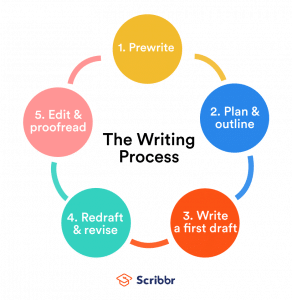
Expert academic writing requires constructive planning, drafting, and revision.
The writing procedure looks different for everyone, but there are five basic steps that will help yous construction your time when writing whatsoever kind of text.
Stride 1: Prewriting
Before you start writing, you need to decide exactly what you'll write about and do the necessary research.
Coming up with a topic
If yous have to come upward with your own topic for an consignment, think of what you've covered in class—is at that place a particular area that intrigued, interested, or even dislocated you lot? Topics that left you with additional questions are perfect, every bit these are questions you tin can explore in your writing.
The telescopic of your topics depends on what blazon of text you're writing—for case, an essay, a inquiry newspaper or a dissertation. Don't selection anything as well ambitious to cover within the word count, or also limited for you to find much to say.
Narrow down your idea to a specific statement or question. For example, an appropriate topic for an essay might be narrowed down similar this:
Doing the enquiry
One time yous know your topic, information technology's fourth dimension to search for relevant sources and get together the data you lot demand. This procedure varies according to your subject and the scope of the assignment. Information technology might involve:
- Searching for primary and secondary sources.
- Reading the relevant texts closely (e.m. for literary analysis).
- Collecting information using relevant research methods (e.g. experiments, interviews or surveys)
From a writing perspective, the important matter is to have enough of notes while you practice the research. Keep track of the titles, authors, publication dates, and relevant quotations from your sources; the data you lot gathered; and your initial analysis or interpretation of the questions you're addressing.
Step 2: Planning and outlining
Especially in academic writing, information technology'southward of import to utilize a logical structure to convey information effectively. It's far amend to plan this out in advance than to try to work out your structure in one case yous've already begun writing.
Creating an essay outline is a useful way to plan out your structure before y'all starting time writing. This should aid you work out the chief ideas you desire to focus on and how you'll organize them. The outline doesn't accept to be final—it's okay if your structure changes throughout the writing process.
Use bullet points or numbering to brand your structure clear at a glance. Even for a short text that won't use headings, it'southward useful to summarize what you'll discuss in each paragraph.
An outline for a literary analysis essay might await something like this:
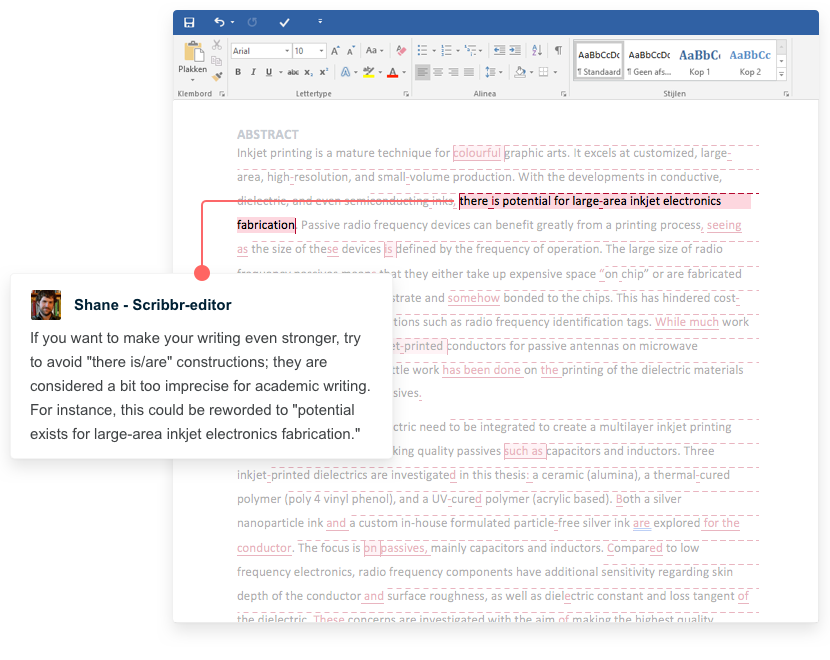
Receive feedback on language, construction and formatting
Professional editors proofread and edit your paper by focusing on:
- Academic mode
- Vague sentences
- Grammer
- Manner consistency
See an example
Footstep 3: Writing a commencement typhoon
Once you take a articulate idea of your structure, it'south time to produce a full outset draft.
This process can exist quite non-linear. For example, it's reasonable to brainstorm writing with the main body of the text, saving the introduction for later one time you have a clearer idea of the text you're introducing.
To give structure to your writing, use your outline as a framework. Make certain that each paragraph has a clear cardinal focus that relates to your overall argument.
Hover over the parts of the case, from a literary analysis essay on Mansfield Park, to come across how a paragraph is constructed.
The character of Mrs. Norris provides another instance of the performance of morals in Mansfield Park. Early in the novel, she is described in scathing terms as i who knows "how to dictate liberality to others: but her love of money was equal to her dearest of directing" (p. seven). This hypocrisy does not interfere with her self-conceit every bit "the well-nigh liberal-minded sister and aunt in the world" (p. seven).
When you motility onto a unlike topic, first a new paragraph. Use appropriate transition words and phrases to show the connections betwixt your ideas.
The goal at this stage is to go a typhoon completed, not to make everything perfect every bit you lot go on. In one case yous have a total draft in front end of you, you'll have a clearer idea of where improvement is needed.
Give yourself a first typhoon deadline that leaves y'all a reasonable length of time to revise, edit, and proofread earlier the final deadline. For a longer text like a dissertation, you and your supervisor might agree on deadlines for private capacity.
Step 4: Redrafting and revising
Now information technology'south time to expect critically at your commencement draft and find potential areas for improvement. Redrafting means essentially adding or removing content, while revising involves making changes to structure and reformulating arguments.
Evaluating the first draft
It can be hard to await objectively at your own writing. Your perspective might be positively or negatively biased—particularly if yous attempt to assess your work presently afterward finishing it.
It's best to go out your work alone for at least a day or ii later on completing the start draft. Come up dorsum after a break to evaluate it with fresh optics; you'll spot things you wouldn't take otherwise.
When evaluating your writing at this stage, y'all're mainly looking for larger issues such as changes to your arguments or construction. Starting with bigger concerns saves you time—there'south no bespeak perfecting the grammar of something yous end up cut out anyway.
Right at present, you're looking for:
- Arguments that are unclear or casuistic.
- Areas where information would be amend presented in a dissimilar order.
- Passages where boosted information or caption is needed.
- Passages that are irrelevant to your overall statement.
For example, in our newspaper on Mansfield Park, we might realize the argument would be stronger with more than direct consideration of the protagonist Fanny Cost, and determine to effort to find space for this in paragraph 4.
For some assignments, you'll receive feedback on your commencement draft from a supervisor or peer. Be sure to pay close attending to what they tell you, equally their advice will usually give you a clearer sense of which aspects of your text demand improvement.
Redrafting and revising
Once you've decided where changes are needed, make the large changes start, as these are likely to have knock-on effects on the balance. Depending on what your text needs, this footstep might involve:
- Making changes to your overall argument.
- Reordering the text.
- Cutting parts of the text.
- Adding new text.
Yous tin get dorsum and forth between writing, redrafting and revising several times until you have a final draft that you're happy with.
Think about what changes you lot can realistically attain in the fourth dimension y'all have. If you are running depression on time, y'all don't want to leave your text in a messy country halfway through redrafting, and so brand certain to prioritize the well-nigh of import changes.
Step v: Editing and proofreading
Editing focuses on local concerns like clarity and sentence structure. Proofreading involves reading the text closely to remove typos and ensure stylistic consistency.
Editing for grammer and clarity
When editing, you want to ensure your text is articulate, concise, and grammatically correct. You're looking out for:
- Grammatical errors.
- Ambiguous phrasings.
- Redundancy and repetition.
In your initial draft, it's common to end up with a lot of sentences that are poorly formulated. Await critically at where your meaning could exist conveyed in a more effective fashion or in fewer words, and watch out for common sentence structure mistakes similar run-on sentences and judgement fragments:
- Austen'due south style is often humorous, her characters are often described as "witty." Although this is less true of Mansfield Park.
- Austen's mode is frequently humorous. Her characters are often described equally "witty," although this is less true of Mansfield Park.
Proofreading for minor mistakes and typos
When proofreading, first await out for typos in your text:
- Spelling errors.
- Missing words.
- Confused word choices.
- Punctuation errors.
- Missing or excess spaces.
Utilize your give-and-take processor's built-in spell check, but don't expect to find 100% of problems in this manner. Read through your text line by line, watching out for problem areas highlighted by the software just also for whatever other issues it might take missed.
For example, in the post-obit phrase nosotros notice several errors:
- Mary Crawfords character is a complicate one and her relationships with Fanny and Edmund undergoes several transformations through out the novel.
- Mary Crawford's character is a complicated one, and her relationships with both Fanny and Edmund undergo several transformations throughout the novel.
Proofreading for stylistic consistency
There are several bug in academic writing where you tin can cull between multiple different standards. For case:
- Whether yous utilise the serial comma.
- Whether yous use American or British spellings and punctuation.
- Where you lot use numerals vs. words for numbers.
- How yous capitalize your titles and headings.
Unless y'all're given specific guidance on these issues, it's your choice which standards y'all follow. The of import matter is to consistently follow one standard for each effect. For example, don't use a mixture of American and British spellings in your paper.
Additionally, you will probably be provided with specific guidelines for bug related to format (how your text is presented on the page) and citations (how you lot acknowledge your sources). Always follow these instructions carefully.
Often asked questions near the writing process
- What'southward the deviation between revising, proofreading, and editing?
-
Revising, proofreading, and editing are different stages of the writing procedure.
- Revising is making structural and logical changes to your text—reformulating arguments and reordering information.
- Editing refers to making more local changes to things like sentence structure and phrasing to make sure your significant is conveyed clearly and concisely.
- Proofreading involves looking at the text closely, line by line, to spot whatever typos and issues with consistency and correct them.
- How can I get better at proofreading?
-
Whether you lot're publishing a blog, submitting a research paper, or even only writing an important e-mail, there are a few techniques you lot tin utilize to brand certain it'due south mistake-complimentary:
- Have a interruption: Set your work aside for at least a few hours and then that y'all can await at it with fresh eyes.
- Proofread a printout: Staring at a screen for besides long can cause fatigue – sit down with a pen and newspaper to check the final version.
- Use digital shortcuts: Take notation of any recurring mistakes (for example, misspelling a particular discussion, switching between U.s. and United kingdom of great britain and northern ireland English, or inconsistently capitalizing a term), and use Find and Replace to fix it throughout the document.
If yous desire to be confident that an important text is error-gratuitous, it might be worth choosing a professional proofreading service instead.
Is this article helpful?
You accept already voted. Cheers :-) Your vote is saved :-) Processing your vote...
Source: https://www.scribbr.com/academic-writing/writing-process/
0 Response to "what order does a writer use to explaina process or tell the story"
Post a Comment